

How Architects Can Replace Paper Site Notes with a Boox Tablet
Why Architects Need More Than a Notebook Architecture is fundamentally an information management profession. On any given project, architects are simultaneously coordinating with: Clients Consultants Contractors Authorities Suppliers Facility operators Every meeting generates information. Every site visit generates information. Every drawing review generates information. The volume quickly becomes overwhelming. Most architects attempt to solve this problem through folders, spreadsheets, emails, and notebooks. Unfortunately, information often becomes fragmented across multiple platforms.
6/4/20264 min read
The Hidden Cost of Paper Site Notes
Every architect knows the feeling.
You arrive on site with a notebook in hand, jot down observations, sketch a detail, record a contractor's comment, and quickly move on to the next issue. By the end of the visit, your notebook contains a wealth of information scattered across several pages.
A week later, someone asks about a specific issue discussed during the site walk.
You remember writing it down.
The problem is finding it.
Was it in the black notebook? The red notebook? The meeting minutes? A loose piece of paper tucked into a drawing set?
For decades, paper notebooks have been the trusted companion of architects. They are simple, reliable, and require no batteries. Yet as projects become more complex and coordination involves larger teams, the limitations of paper become increasingly apparent.
Site notes are often disconnected from photographs. Sketches are difficult to share. Meeting comments become buried beneath pages of unrelated information. Important observations can be lost simply because they are difficult to retrieve.
The challenge is not recording information.
The challenge is finding it when it matters.
After years of relying on traditional notebooks, I began searching for a better solution—one that preserved the natural feel of handwriting while providing the advantages of a digital workflow.
That search led me to E Ink tablets.
Why Architects Need More Than a Notebook
Architecture is fundamentally an information management profession.
On any given project, architects are simultaneously coordinating with:
Clients
Consultants
Contractors
Authorities
Suppliers
Facility operators
Every meeting generates information.
Every site visit generates information.
Every drawing review generates information.
The volume quickly becomes overwhelming.
Most architects attempt to solve this problem through folders, spreadsheets, emails, and notebooks. Unfortunately, information often becomes fragmented across multiple platforms.
A site observation may be written in a notebook.
The supporting photograph sits on a phone.
The action item is buried inside an email.
The related drawing is stored elsewhere.
Finding everything later becomes a time-consuming exercise.
What architects truly need is not another notebook.
We need a system.
Discovering E Ink
At first glance, an E Ink tablet appears almost too simple.
The screen is monochrome.
There are no flashy animations.
The refresh rate is slower than a conventional tablet.
Yet these limitations are precisely what make E Ink devices effective.
Unlike traditional tablets, E Ink devices are designed primarily for reading, writing, and thinking.
The experience feels remarkably similar to paper.
You can sketch.
You can annotate PDFs.
You can write meeting notes.
You can review drawings outdoors without screen glare.
Most importantly, the device encourages focus.
Instead of becoming distracted by notifications, social media, or endless browser tabs, you remain focused on the task at hand.
For architects, this is surprisingly powerful.
My Architecture Workflow Using a Boox Tablet
Over time, I developed a workflow that mirrors the way architects naturally work.
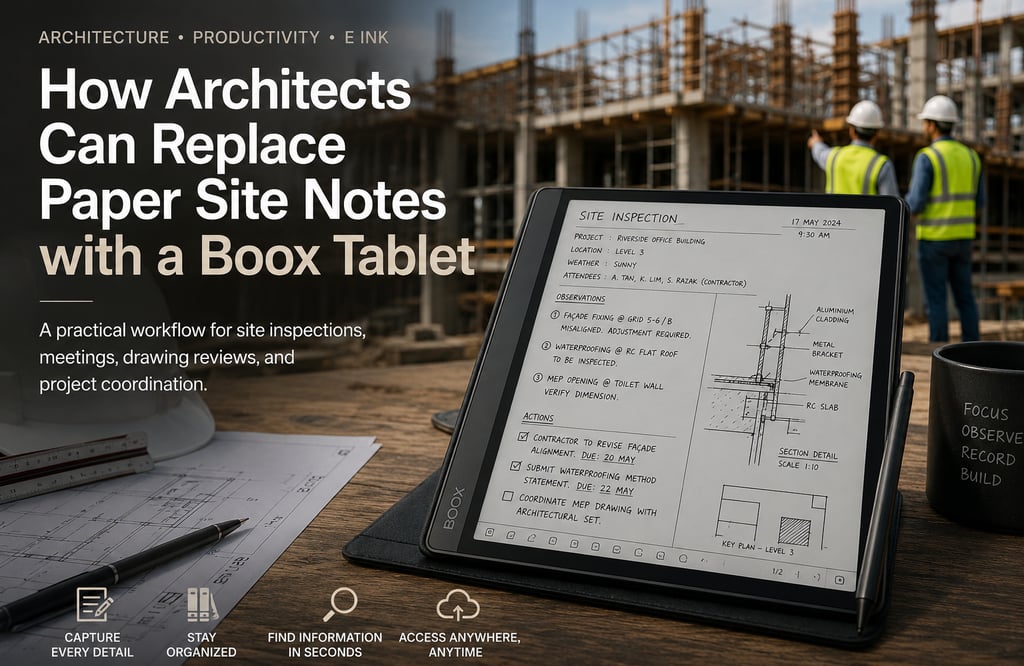
Site Inspections
During site visits, I use dedicated templates to record:
Date and time
Weather conditions
Attendees
Observations
Defects
Follow-up actions
Simple sketches can be added directly beside notes.
Instead of carrying multiple notebooks, all project information remains organized within a single device.
Design Coordination Meetings
Design meetings often generate dozens of action items.
Rather than writing notes randomly across pages, I use structured meeting templates that capture:
Discussion topics
Decisions made
Responsible parties
Due dates
This allows meeting notes to remain consistent across every project.
Over time, consistency becomes one of the greatest productivity advantages.
Drawing Reviews
One of the most valuable features is PDF markup.
Architects spend countless hours reviewing drawings.
Being able to write directly on digital PDFs combines the familiarity of redlining with the convenience of digital storage.
Comments remain attached to the drawing itself.
There is no need to retype handwritten notes afterward.
Consultant Coordination
Consultant meetings frequently require referencing previous discussions.
Because notes remain digitally organized, it becomes much easier to retrieve historical decisions.
Instead of flipping through months of notebooks, information can be located almost instantly.
Why Templates Matter
Many people assume productivity comes from working harder.
In reality, productivity often comes from reducing decisions.
Templates eliminate the need to reinvent a note-taking structure every time you start a new meeting or site visit.
Think about how much time is wasted deciding:
Where to write the date
How to organize action items
How to structure observations
How to track responsibilities
A good template removes all of those decisions.
The result is greater consistency, better records, and less mental effort.
This is one reason why pilots use checklists and why hospitals use standardized procedures.
Consistency reduces errors.
The same principle applies to architecture.
The Future of Architectural Documentation
The profession is becoming increasingly digital.
BIM has transformed documentation.
Cloud collaboration has transformed coordination.
Mobile devices have transformed communication.
Yet many architects still rely on note-taking methods that have remained largely unchanged for decades.
There is nothing wrong with paper.
In many situations, it remains a wonderful tool.
The question is whether paper continues to be the most effective tool for managing the growing complexity of modern projects.
For me, the answer was no.
The ability to handwrite naturally while maintaining a searchable, organized, and portable record of project information has fundamentally changed the way I work.
The goal was never to eliminate handwriting.
The goal was to preserve its strengths while removing its weaknesses.
That is where E Ink excels.
Final Thoughts
Architecture is ultimately about observation.
Great buildings begin with careful attention to details that others overlook.
A crack in a wall.
A subtle change in level.
A comment made during a coordination meeting.
A sketch drawn in the margin of a notebook.
The challenge is not seeing these things.
The challenge is capturing them before they disappear.
Technology should help us think more clearly, not distract us.
For architects seeking a digital note-taking system that feels natural, E Ink offers a compelling alternative to both traditional notebooks and conventional tablets.
It combines the familiarity of paper with the organization of the digital world.
And in a profession built on managing information, that combination can make all the difference.