

The Cost of Inaction: Why Waiting is More Dangerous Than Failing
We’ve all been there. That project we keep putting off. That conversation we avoid. That dream we say we’ll start “someday.” We tell ourselves we’re not ready. We’re still figuring it out. We want to get it right the first time. But beneath all that logic lies something else—something most of us don’t want to admit: we’re afraid. Afraid to fail. Afraid to be judged. Afraid to waste time or get it wrong. So, we wait. And that wait? That inaction? It costs us more than failure ever could.
6/4/20264 min read
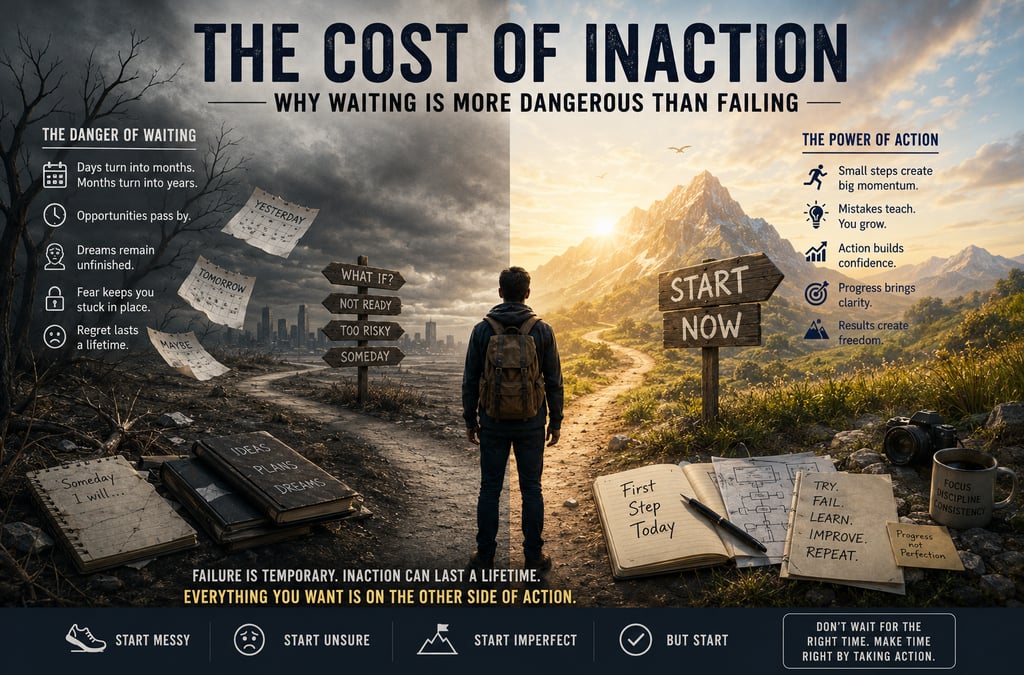
We’re taught to fear failure as if it’s the worst possible outcome. But that’s a lie. Because failure, at the very least, moves you forward. It gives you feedback. It teaches. It stretches you. It prepares you for the next step.
Inaction does none of that. It keeps you where you are. It feels safe, but it’s stagnant. And the longer you stay there, the harder it becomes to move.
“Most people live their entire lives stuck in a cycle of indecision, overthinking, and second-guessing… But waiting is the enemy of progress.”
We live in a world that glorifies getting it right. We scroll through highlight reels of other people’s wins. We see the polished, the perfect, the successful—and we think, “I need to get it right the first time too.”
So we hold back. We spend days, months, even years in planning mode. We tell ourselves we’re “being strategic.” But planning without action is just procrastination in disguise.
I remember hearing about a photography class that perfectly illustrates this. The professor divided students into two groups. The first group was told they’d be graded on the quantity of photos they took. The more, the better. The second group? They were told to focus on quality—to take one perfect photo and submit only that.
By the end of the semester, the best photos came not from the group focused on perfection, but from the group that simply kept clicking. Every photo, every mistake, every blurry image taught them something. Their instincts improved through repetition, through real effort, through doing.
Meanwhile, the perfectionist group spent so much time planning and analyzing that they barely produced anything remarkable. Their pursuit of the perfect image robbed them of the chance to grow.
And isn’t that exactly what happens in real life?
We keep waiting for the perfect conditions. The perfect plan. The perfect idea. But those who get better, who go further, who end up with results—they’re the ones who start imperfectly and keep showing up.
“You do not need a perfect plan. You just need to move.”
The longer we wait, the heavier the task feels. We start carrying around mental weight—guilt, shame, regret—for all the things we haven’t started. The book we wanted to write. The job change we kept talking about. The business we never launched.
Inaction starts as a small pause. Then it grows into a pattern. A habit. A way of life.
Eventually, it hardens into regret.
And that regret becomes far more painful than any temporary sting of failure. Because the truth is, most people don’t regret what they did—they regret what they didn’t do.
They regret not trying.
They regret letting fear win.
They regret waiting too long to start.
“Inaction is failure in slow motion.”
The beautiful thing about taking action—even if it fails—is that it gives you something to work with. It hands you clarity. It shows you what doesn’t work, which brings you one step closer to what does.
We like to think that confidence comes first—that if we just feel more confident, we’ll finally act. But it’s the other way around. Action creates confidence. Every step you take builds self-trust. Every challenge you face and get through—especially the ones that don’t go as planned—proves to you that you’re capable, adaptable, resilient.
“Confidence does not come from wishing. It comes from proving to yourself that you can handle challenges.”
What most people don’t see is the emotional cost of staying stuck. You wake up with a vague sense of pressure, of weight, of “I should be doing something.” But you don’t. And so the doubt grows. The anxiety builds. And the idea you once felt excited about starts to feel overwhelming—like something you’ll never actually do.
But you can break that cycle. Not by waiting until you feel ready, but by starting anyway. Because readiness is a lie. You won’t feel ready until you’ve already begun. Until you’ve taken the first few messy, uncomfortable steps. Until you’ve fallen a few times and realized, “Hey, that wasn’t so bad.”
There’s a quiet power in getting started, even before you feel prepared. Even before it’s perfect. Even before you know how it ends.
Because the ones who win in life aren’t the ones with the best ideas—they’re the ones who move. Who try, fail, learn, and improve. While you’re still thinking about your first draft, they’ve already gone through ten versions and found something that works.
“While you’re still working on your first draft, they’ve already launched, learned, and leveled up.”
That’s the real advantage of action: iteration. Every try teaches you something. Every attempt builds muscle memory, sharpens instinct, and gets you closer to something great.
On the flip side, inaction leaves you with nothing. No experience. No insight. No momentum. Just the same idea in your head, gathering dust.
So, yes—failure is the mother of success. It always has been. Not because failing is fun, but because failing is formative. It chisels away at the things that don’t work. It sharpens your judgment. It builds your endurance.
And when you keep taking action, failure becomes less and less intimidating. It just becomes part of the process.
The reality is, you're going to fail. You're going to make mistakes. You're going to get things wrong. But that's not a reason to avoid action. It’s the very reason to take it.
Because failing once teaches you more than waiting for years ever could.
Let today be the day you break the pattern. That thing you’ve been putting off—start it. Even if it’s a tiny step. Even if you’re still scared. Especially if you’re still scared.
Stop waiting for the conditions to be right. They rarely are. Stop waiting to feel ready. You probably won’t. Stop waiting for the fear to vanish. It won’t—but it does shrink with motion.
“Everything you want is on the other side of a decision backed by action.”
So, act.
Start messy. Start unsure. Start imperfect. But start.
Because waiting is more dangerous than failing.
And the cost of inaction?
It’s everything you could have become.