

Why I Chose a Boox Tablet Over an iPad (Even Though the iPad Has Better Specs)
The Strange Reality of Modern Technology. Every year, our devices become more powerful. Processors become faster. Screens become brighter. Applications become more capable. Storage becomes cheaper. Yet despite all these improvements, many people feel less focused than ever before. We own devices capable of performing billions of calculations per second. Yet we struggle to sit quietly with our own thoughts for ten minutes. This realization fundamentally changed how I evaluate technology. I stopped asking: "Which device can do more?" And started asking: "Which device helps me think better?" That question ultimately led me to choose a Boox tablet over an iPad.
6/4/20264 min read
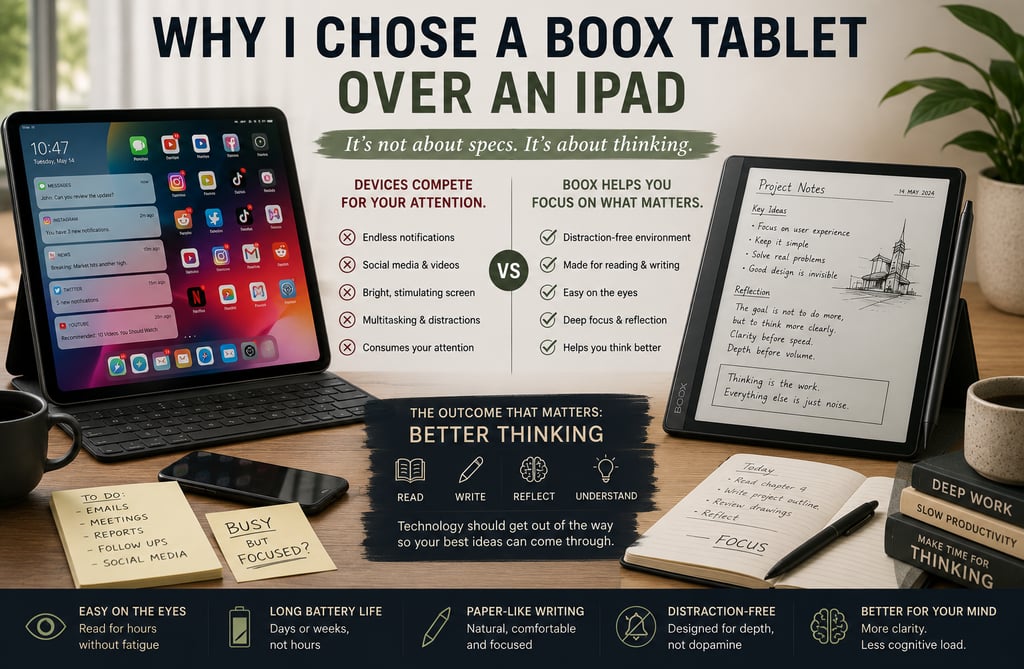
On Paper, the iPad Wins
If specifications were the only thing that mattered, this article would be very short.
The iPad is objectively superior.
It has:
A faster processor
A brighter screen
Better graphics
More applications
Better cameras
Better speakers
Better video performance
In many cases, a similarly priced iPad completely outclasses a Boox tablet.
The same can be said for many Android tablets.
If we compare hardware specifications alone, the decision appears obvious.
Yet despite knowing this, I still reach for my Boox device every day.
Why?
Because the goal was never to own the most powerful computer.
The goal was to think clearly.
The Problem With Devices That Can Do Everything
Modern tablets are incredible.
That is also their greatest weakness.
Every device today competes for attention.
Notifications.
Messages.
Videos.
News.
Social media.
Recommendations.
Advertisements.
Infinite scrolling.
These systems are not accidental.
Entire industries are built around keeping our eyes on screens for as long as possible.
The result is a subtle but significant shift.
Our devices no longer serve our attention.
Our attention serves our devices.
The Cost of Constant Stimulation
Imagine trying to read a book in a room where someone interrupts you every two minutes.
You would struggle to follow the narrative.
You would lose your train of thought.
You would forget important details.
Yet this is precisely how many of us work today.
We attempt to think deeply while surrounded by digital interruptions.
The problem is not intelligence.
The problem is fragmentation.
Great thinking requires continuity.
Ideas need time to develop.
Thoughts need room to connect.
Insights often emerge only after prolonged periods of focus.
Unfortunately, modern devices are optimized for engagement rather than contemplation.
Thinking Is Different From Consuming
One of the most important lessons I've learned is that consuming information is not the same as processing information.
We often mistake activity for progress.
Reading twenty articles does not guarantee understanding.
Watching fifty videos does not create wisdom.
Saving hundreds of notes does not produce insight.
Knowledge grows when information is transformed through reflection.
This is where writing becomes powerful.
Writing forces thinking.
Writing reveals assumptions.
Writing clarifies confusion.
Writing turns vague impressions into structured understanding.
A good thinking device should encourage this process.
Not interrupt it.
Why E Ink Changes the Experience
At first glance, E Ink appears inferior.
The screen refreshes more slowly.
The display is monochrome.
Animations are limited.
Everything feels less exciting.
Ironically, this is precisely why it works.
The device does not constantly compete for your attention.
It fades into the background.
Instead of staring at a glowing screen, you focus on the words.
Instead of browsing endlessly, you read.
Instead of consuming, you reflect.
The technology becomes invisible.
The thinking becomes visible.
The Difference Between Tools and Toys
This distinction became increasingly important to me.
Many devices today function as both tools and entertainment platforms.
Unfortunately, entertainment often wins.
You open the device intending to review notes.
Twenty minutes later, you're watching unrelated videos.
The device has succeeded.
You have not.
A Boox tablet feels different.
Its limitations create boundaries.
Those boundaries create focus.
That focus creates better thinking.
In many ways, the device resembles a notebook more than a computer.
And that is exactly why it works.
Why Architects, Writers, and Thinkers Gravitate Toward E Ink
There is a reason certain professions are drawn to E Ink devices.
Architects.
Researchers.
Writers.
Students.
Pastors.
Academics.
These professions share a common requirement.
They need uninterrupted thought.
Their value does not come from responding quickly.
Their value comes from thinking deeply.
A better notification system does not necessarily make a better architect.
A faster processor does not necessarily produce a better sermon.
A brighter screen does not necessarily lead to better ideas.
The quality of the outcome depends largely on the quality of the thinking that produced it.
The Real Question Isn't Performance
Most technology reviews ask:
How fast is it?
How powerful is it?
How many features does it have?
These questions matter.
But they are not the most important questions.
Perhaps we should ask:
Does this device help me focus?
Does it encourage reflection?
Does it improve comprehension?
Does it support deep work?
Does it help me produce better ideas?
When evaluated through this lens, the conversation changes dramatically.
The Goal Is Not More Information
Many people believe productivity comes from acquiring more information.
In reality, productivity often comes from making better use of existing information.
We already know more than we implement.
We already read more than we remember.
We already consume more than we apply.
The bottleneck is rarely access to information.
The bottleneck is thoughtful processing.
This is where E Ink excels.
It creates an environment where information can mature into understanding.
Why I Ultimately Chose Boox
I did not choose a Boox tablet because it was more powerful than an iPad.
It isn't.
I did not choose it because it had better specifications.
It doesn't.
I chose it because it consistently helps me achieve the outcome I care about most.
Clearer thinking.
Better reading.
More intentional writing.
Deeper reflection.
The value of a tool should not be measured solely by what it can do.
It should be measured by what it enables you to become.
Final Thoughts
We live in a world obsessed with performance.
Faster processors.
Larger screens.
More applications.
More features.
More everything.
Yet some of the most important human activities require less.
Less distraction.
Less stimulation.
Less noise.
Reading.
Writing.
Reflecting.
Thinking.
Sometimes the best technology is not the device that does the most.
It is the device that gets out of the way.
And for me, that is why a Boox tablet continues to earn a place on my desk long after the excitement of specifications has faded.
Because in the end, the goal was never to own a better tablet.
The goal was to become a better thinker.